Akhanda Bharatam

Click here to know about Akhanda Bharatam (अखंड भारतम्)

Sanatana Dharmam

Click here to know about Sanatana Dharmam (सनातन दर्मम्) and Hinduism

Thursday, 8 August 2013

Women in Vedic Culture


MADALASA : 

Madalasa was the daughter of Vishwavasu, the Gandharva king. She was also a great inspiration to her sons. Ritdhvaj, the son of the powerful king Shatrujit, was her husband. When Shatrujit died, Ritdhvaj took the position of king and engaged in the royal duties. In due course, Madalasa gave birth to a son, Vikrant. When Vikrant would cry, Madalasa would sing words of wisdom to keep him quiet. She would sing that he was a pure soul, that he has no real name and his body is merely a vehicle made of the five elements. He is not really of the body, so why does he cry?

Thus, Madalasa would enlighten her son with spiritual knowledge in the songs she would sing to him. Because of this knowledge, little Vikrant grew up to be an ascetic, free from worldly attachments or kingly activities, and he eventually went to the forest to engage in austerities. The same thing happened to her second son, Subahu, and her third son, Shatrumardan. Her husband told her that she should not teach the same knowledge to their fourth son, Alark, so that at least one of them would be interested in worldly activities and take up the role of looking after the kingdom. So to Alark she sang a song of being a great king who would rule the world, and make it prosperous and free from villains for many years. By so doing he would enjoy the bounty of life and eventually join the Immortals. In this way, she trained her son Alark from the beginning of his life in the direction he would take. This is how a mother can influence her child in whatever potential may be possible, whether materially or spiritually, by imparting noble thoughts to open the avenues of activities for her children.

ANASUYA :

Anasuya was a woman who could bring back the life of a dead sage due to the power of her own austerity and devotion to her husband. She showed that devotion to a qualified husband gives the wife fame, power and is the fulfillment of her dharma. Anasuya was the wife of the sage Atri. Her mother was daughter of the sage Svayambhuva and her father was Kardama Muni. Her fame had spread throughout both the Earth and the planets of the Devas.

According to the Markandeya Purana, there was once a sage named Mandasya who cursed a brahmana named Kaushika to die the next morning at sunrise. When Kaushiki, Kaushika's wife, heard the news, she vowed that by the power of her chastity the sun would never rise. When the sun did not rise for many days, everyone started to become alarmed. Brahma then told the other demigods to go to Anasuya and she could assist them to continue the sunrise by the force of her moral power. Anasuya then entreated Kaushiki to allow the sunrise to resume. Kaushiki then allowed the sunrise to take place, but her husband immediately expired because of the curse. Yet, Anasuya brought the husband back to life by the power of her own austerity and devotion to her husband. Being pleased by this, the demigods gave Anasuya the blessing to have her wish for three sons who would be reincarnations of Brahma, Vishnu and Shiva. Thus, Brahma appeared as Soma, Vishnu as Dattatreya, and Shiva as Durvasa. Of course she was also greatly honored by her husband who said to Sri Rama when Rama once visited Atri's ashrama during His exile, that Anasuya was a great lady, following the path of austerity and deserves the salutations of all beings. Anasuya was a bright example among women.

SAVITRI : 

Savitri was the only child of a king named Ashwapati, the king of Madra-Desha, as explained in the Mahabharata and Matsya Purana. He had performed austerities to please Lord Brahma and his consort, Savitri Devi, to have progeny by chanting the Savitri prayer. When a daughter arrived, he named her Savitri, and she grew to be a girl of great beauty and character, and wonderful personality and qualities. Unfortunately, her father could find no suitable husband for her when she became of age. So he sent her to different parts of the country so she could find a husband she deemed acceptable. After some time Savitri decided to marry Satyavana, but he was the son of Dyumatsena who was the blind and exiled king of Shalya-Desha. Because of this, they lived in the forest. Satyavana was simple but bore a countenance of royalty, which attracted Savitri.

Savitri returned to her father to relate the news, however the sage Narada Muni happened to be there and heard it and revealed that Satyavana was highly qualified but was to live for only one year longer. But Savitri had made her decision and would not marry another. So to fulfill Savitri's intention, the king arranged for a wedding.

One day, after living in the forest for a year, Satyavana went off to chop some wood as usual. Savitri had been observing penance for many months and followed him into the woods. On this day Satyavana fell down with a headache. At that same time, Savitri saw a ferocious person approaching and could recognize that it was Yama, the lord of death, who was coming to take Satyavana since his life was ending. After Yama had taken Satyavana, Savitri started to follow Yama. He asked her not to follow him and even promised her many boons, all but the life of her husband. Nonetheless, Savitri continued to follow him until he granted her wishes.

Savitri asked Yama for her father-in-law's eyesight to return, along with his lost kingdom. Then she asked for one hundred sons for her father. All these were granted as Yama became increasingly impatient. Then she asked for one hundred sons for herself as well, all of them as handsome and wise as Satyavana, to which Yama also agreed without much thought. But then he realized his mistake and had to allow Satyavana to continue with his life. Thus by the power of Savitri's austerity, wisdom and devotion, she conquered death for her husband and blessed her own father and father-in-law as well.

Panchakarma and its significance


Today while going through net i got this article wrote by Dr.Savitri suri on this topic and i remember many members asked me about this.
This is lengthy as i cant reduce anything

Panchakarma- The detoxification therapy in Ayurveda 

According to ayurvedic texts our body is crisscrossed by srotas or channels or tube like structures. This net work contains both microscopic and macroscopic channels. ( Digestive system, nervous system , circulatory system etc are few examples of these channels). Innumerable physiological process like breathing, blood circulation, secretions of enzymes, hormones etc , flow of signals, supply of nutrients, filtration of toxins , excretion of waste etc are aided by these tubular structures.

Diseases occur when toxins get accumulated in body and clog these channels. Unhealthy diet, lifestyle, stress, changes in environment etc lead to accumulation of toxins in body. These accumulated toxins have to be expelled out in order to keep our body healthy. Through panchakarma therapy these toxic clogs are removed to normalize the physiological process. Hence panchakarma therapy is called as detoxification therapy. Panchakarma therapy can be administered to a normal person to prevent diseases and keep his body healthy. The ideal season to expel toxins through this therapy, is rainy season.


Panchakarma therapy is also used as a purifactory therapy to cleanse the body before starting a treatment. A diseased body can be compared to a soiled cloth which can not be colored as we desire. Hence to attain the maximum benefits , the body has to be purified or cleaned before starting the treatment. The cleared channels help medicines to penetrate the deeper tissues.

The detoxification process contains three steps

Purvakarma - Preparations which have to be done before the detoxification
Pradhanakarma – The main detoxifying process
Pashchat karma – Rehabilitating the diet and lifestyle after the detoxification process.


Purvakarma : These steps are adopted to soften the channels and toxins, so that the toxins can get detached and eliminated easily during main detoxifying process. The hard toxic clogs are made to get loosened by increasing body fire or agni. Medicines are administered internally for this purpose. This process is called as “deepana and pachana” in ayurveda. ( the duration of this process is 3-5 days depending on the conditions and diseases) .Later whole body is oleated internally and externally with medicated oil or ghee. This process is called as “Snehana” .

Internal oleation is done by administering small quantities of medicated oil or ghee internally. The duration of internal oleation , quantity and type of medicated oil or ghee is determined by the physician after analyzing the body constitution of the patient. The patient has to eat liquid food or light food on the day prior to internal oleation. After consuming the medicated oil or ghee the patient is encouraged to sip warm water frequently. When medicated oil or ghee is completely digested, the patient is advised to consume light food.

External oleation is done after the completion of internal oleation.. The whole body or body part is massaged with medicated oil. Few types of external oleation are used as treatment methods. They are

Abhyanga ; Massaging whole body
Lepa – Smearing medicated oil and herbs
Mardana – Kneading the body parts with fingers and fists.
Padaghata – Tampling the body with foot.
Gandusha - The mouth is filled with oil and is retained for a longer period of time.
Parisheka (Pizhichil ) - The warm medicated oil is poured continuously over the entire body for an extended period of time.

Soon after oil massage the body or body part is exposed to heat through steam bath or other heating methods according to the physician’s choice. This process of exposing body to heat is called as swedana or sweating. Both snehana and swedana help to soften the channels and toxin clogs. Elimination of toxins becomes easy when channels are soft and toxins are loose.

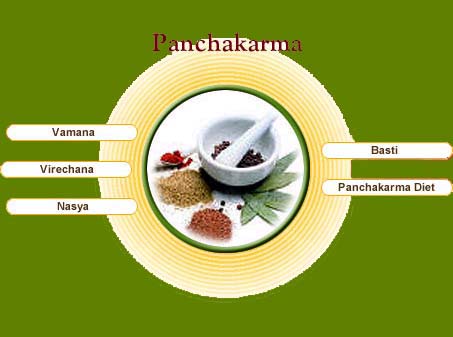
Pradhana Karma : This is the main detoxifying process. The softened and loosened toxins are expelled from body by five methods. Considering these five major detoxifying methods the whole process is named as “Panchakarma” (Pancha = 5, Karma = process ) .

Vamana (through Emesis),
Virechana (Purgation),
Niruha basthi Basthi (enema with herbal concoctions ),
Anuvasana basthi (enema with medicated oil)
Nasya (nasal drops) and Raktamokshana (Blood letting).

Physician can chose any of these detoxifying methods according to disease and prevalence of doshas.

Paschat Karma: A strict diet and lifestyle procedure has to be followed through out Panchakarma treatment. The rehabilitative procedures to bring back the diet and lifestyle to normal are considered as “paschat Karma”. In this stage the digestion power is brought back to normalcy. Medicines are administered to rejuvenate the body or to treat the disease. During panchakarma treatment the following rules have to be strictly followed.

One has to use only warm water to drink, bathe and for other activities.
Person who is undergoing panchakarma therapy can not indulge in sex.
Sleeping in daytime is contraindicated.
Natural urges should not be controlled.
Exposures to extreme temperatures or weather conditions have to be avoided.
Keeping awake at night is not advisable
Foods which cause indigestion can not be consumed.
Exercise and mental stress have to be avoided.

The Panchakarma therapy is not advisable for persons in whom the following conditions exist.

Menses
Lactation
Cancer of the Lungs or Testicles
Melanoma
HIV or AIDS
Extreme Obesity
Lympho-Sarcoma
Hypertension
Congestive Heart Failure
Emaciation
Any Active Infectious Disease
Pregnancy
Angina Pectoris

The benefits of Panchakarma are as follows

Toxins are eliminated from body .
Doshas get Balanced.
Stress is reduced and body gets relaxed.
Slows ageing process and increases the lifespan.
Increases glow and luster of skin.
Boosts body immunity and body energy level.
Enhances strength, energy, vitality and mental clarity
Reduces dependence on alcohol, tobacco and drugs.
Help to implement healthy diet and lifestyle.


Science behind Lord Siva

The blue neck (Neelkanth) of Lord Shiva represents that one should neither take the vices out nor suppress them but alter or modify them.
The blue colour symbolizes slow poison or the negative thoughts. The same in the neck indicates that the poison is neither to be drunk nor to be spitted out but to be kept in the throat temporarily so that it can be neutralized at appropriate time.
The well described slow poisons are attachments, anger, greed, desires ,jealousy and ego ( Kama, Krodha, Lobha, moha,dwesha and Ahankar).

Lets us take anger as an example. The root cause of any anger is non fulfillment of desires. Anger in turn can be expressive or suppressive. Expressed anger will lead to aggressive behavior and resultant social unhealthiness. It can also rupture a heart blockage and precipitating a heart attack or rupture of a blood vessel in the brain leading the brain hemorrhage.

Suppressed anger on the other hand will release chemicals in the body leading to illnesses like acidity, asthma, diarrhea and cholesterol deposition in the blood vessels leading to future blockages.

One can manage anger with taking the right and not the convenient action, neutralizing anger by willful cultivation of opposite positive thoughts etc. For example the process of silently passing on love to any individual can take away the angry thoughts from the mind (love is opposite of anger).

Anger evokes physiological responses that are potentially life threatening in the setting of heart blockages.
The message by Shiva was given in our Vedic knowledge and in different Upanishads. The scientists today are only validating those concepts by way of studied all over the world. And unless the messages come to us from the west we do not believe them.

In the modern contest angina or heart pain is characterized by episodic variations in the frequency and severity of symptoms coincident with periods of emotional stress.

Stress related angina is not as a result of progressive coronary blockages but due to an increase in oxygen demand due to stress. Appreciation of this concept will help to rule out "true" unstable angina due to progressive coronary disease from recurrent angina that results from an increase in oxygen demand related to emotional stress. The former requires aggressive medical or surgical therapy; the latter, a demand-induced angina, responds to tranquilizers and stress reducing methodologies.

.Anger has many phases. Anger Expression Inventory, assesses anger frequency (trait anger), anger intensity, anger expression (anger-out), anger suppression (anger-in) and anger recall.

Dr. C. Noel Bairey Merz, from Women's Health at Cedars-Sinai Medical Center has shown that anger and hostility alone are not predictive for coronary artery disease in women, but women who outwardly express anger (anger-out) are at increased risk especially if they also have other risk factors: age, diabetes and high cholesterol levels. The overt expression of anger toward other persons or objects is the most "toxic" aspect of hostility in women. The findings are a part of Women's Ischemia Syndrome Evaluation (WISE) Study, a multi-center, long-term investigation sponsored by the National Heart, Lung and Blood Institute.

Anger-in is also related to severity of blockages. Dr. T M Dembroski and group have shown that potential for Hostility and Anger-In are significantly and positively associated with the heart blockages disease severity, including angina symptoms and number of heart attacks. Suppressed anger is also associated with increased carotid arterial stiffness in older adults, a condition making them prone to future heart attacks and paralysis. They published their data in 1985 in Psychosom Med.

Suppressed anger has also been shown to increase blood pressure by S P Thomas and group from University of Tennessee.

Suppressed anger is further dangerous as the recall of anger now has been shown by Dr D Jain and group from Yale University in 2001 to be associated with angina, heart LV dysfunction and rise in upper blood pressure.

G Ironson and group from Department of Psychology, University of Miami has shown that anger recall produces more stress than the actual stress in a treadmill. In most studies psychological stressors used are mental arithmetic, recall of an incident that elicited anger, giving a short speech defending oneself against a charge of shoplifting.

They also showed that intensity of anger is associated with severity of angina. In their study vasoconstriction only occurred with high levels of anger. There also showed that there was no narrowing of non-narrowed arteries indicating that anger recall produce coronary vasoconstriction in previously narrowed coronary arteries.

It is clear from the western studies that anger ( or any vices) neither should be aggressively expressed nor suppressed but should be continuously positively altered.


Science in Siva Pooja

Know the science in the worship of Lord Shiva on Mahashivratri : 

"Om Namah Shivaya"

Kailaasarana Shiva Chandramouli
Phaneendra Maathaa Mukutee Zalaalee
Kaarunya Sindhu Bhava Dukha Haaree
Thujaveena Shambho Maja Kona Taaree 


Meaning: Oh, Lord Shiva, who is seated on Mount Kailas, whose forehead is decorated with the moon and the king of serpents as a crown, who is the Ocean of Mercy and the remover of delusion, You alone can protect me.

I surrender to thee.

1. Emitting waves of Knowledge, Devotion and renunciation
Predominantly 'sattva' waves of knowledge, 'raja' waves of devotion and 'tama' waves of Renunciation (Vairagya) are emitted by the 'Shivpindi'. During Mahashivratri, the emission increases by 30 percent.

2. Emission of subtle vibrations of chaitanya, bliss and peace
The 'Shivpindi' emits subtle vibrations of chaitanya, bliss and peace. During the Mahashivratri, the emission increases by 25 percent. This helps purify the subtle-body of one who worships the Shivpindi on this day. The 'sun' or the 'moon' channels in the body get activated as per necessity. The capacity to absorb the sattvaguna and chaitanya also increases. Due to the presence of the unmanifest Shiva principle in the Shivpindi and the vibrations of peace emitted, the Shivpindi remains cool and the mind too experiences peace. Worship of Shivpindi with devotion, activates the dormant Shiva principle. An offering of puffed rice and milk reaches Lord Shiva in the subtle form.

3. Receiving the 'tarak or marak tatva (element)' as required
There is a meeting of the evident and the unevident elements along with the 'tarak and marak tatva' in the Shivpindi. (Tarak = Saviour; Marak = Destroyer). That is how worshipers receive the required element. The temperature of the Shivpindi increases due to the emission of the marak tatva and there one experiences bliss. Similarly, when the tarak tatva is emitted, the temperature drops and one experiences peace and bliss.

Offerings made to Lord Shiva : 

Bilvapatra :

It contains 2% Shiva tatva. By offering bilvapatra to the Shivpindi on Mahashivratri, the manifest Shiva tatva near the stalk of the bilvapatra gets activated. Due to this, waves of chaitanya as well as Shiva tatva are emitted by the bilvapatra. The bilvapatra attracts 20% of the Shiva tatva present in the Shivpindi towards itself. 

Application of holy ash (Bhasma) :

Tripundra refers to the three horizontal stripes of holy ash applied to the forehead. These stripes symbolise spiritual knowledge, purity and penance, thus they represent the three eyes of Lord Shiva.

Ritualistic worship of the pindi :

Only cold water and bel is offered to Lord Shankar's pindi.

Circumambulation (pradakshina) : 

When circum-ambulating one should begin from the left side and continue till the channel of the shalunka from where the water offered during the ritualistic bathing (abhishek) flows. The flow of a shalunka is not crossed because it affects the formation of semen and the five internal vital energies.

Chanting the Name of Lord Shiva or 'Om Namah Shivaya' 

'Namaha Shivaya is Shiva's five-syllabled mantra. It means :

• na = Foremost deity of all the regions (lokas) 
• ma = Bestower of supreme spiritual knowledge (gyan) & redeemer of the greatest of sins 
• shi = Benevolent, serene and responsible for initiation by Lord Shiva 
• va = Symbolic of a bull as the vehicle and Vasuki and Vamangi energy (shakti) 
• ya = Auspicious abode of Supreme Bliss and Lord Shiva.

Om represents an unmanifest state beyond the 3 gunas (elements of sattva, raja & tama). We bow to Lord Shiva, from whom Om was created.

Science behind Shiva Linga


Lord Shiva is known as Mahadev due to the instinct characteristics which he represents. The form in which Lord shiva is represented is called a Ling. Infact, Lord Shiva is the fundamental god. He is known as prajapati Shiva. There is no origin or form which can be associated with Shiva. Man needs a symbol to worship so the ling was created “Ling means symbol”. For example Vishnu’s Ling is a chakra or if someone was wearing a stethoscope you would say he was a doctor. A ling is only a symbol to identify something. This symbol that we call a Shivling has behind it a scientific explanation. 

The beginning of life is called Hiranyagarbha. This is the thread or formula of life which is complete in itself and reproduces itself without any organ. It multiplies itself from 1 to 2, then from 2 to 4 and so on. It is the basic culture of any form of life. It can be compared to DNA which contains the genetic code. It is indestructible, reproduces itself and contains the specifications of any generation. So, how did our ancestors explain DNA? The structure of DNA as we know was first described by scientists in 1953. Nobody had imagined this type of structure. It is also difficult to explain the structure of DNA to a common man. Now we can see the 3D structures with movements on TV. Before that, it was imagined as two spiral interwined staircases. Our rishis saw this structure through their meditation and explained it the same way modern science explains DNA. They concluded that it was helical, produced itself, and according to our scriptures, it first originated from Lord Shiva.

The rishis imagined that Prajapati must have created a mound first. You have to make a mound before creating anything, for example, a clay mound for a statue and a store mound for a sculpture. Our rishis had imagined this round mound, the Shivling, was wrapped with a snake, which might model DNA. To describe more complex DNA, a pair of snakes wrapped around each other can be visualized to represent a double helix, as rishis explained. The rishis also said that it was the base structure and entire nature began with it. This was determined by our rishis to be the fundamental and elemental point with which any life form could being.

Modern science corroborates the findings of our scriptures that DNA is like a thread and is so small that it can not be seen with naked eyes it reproduces itself by multiplying itself and cannot be destroyed. An object can be destroyed, but its DNA will exist in one form or another. The properties suggested for DNA by modern science had also been suggested in our scripture. So the Shivling is not just a mere symbol. Our rishis wanted to give a message to the masses that you can see the smallest form of nature in the form of the Shivling. The Shivling represents the atomic structure. When they created the Shivling it was imagined that there was one Hari and one Har in the ling. Har is shiva, and Hari is Vishnu. shiva and Vishnu are present in this Ling. Jalhari has three lines because three signifies “multiple” in Sanskrit. In our atomic structure, there are protons and neutrons which are surrounded by fast spinning electrons.

Our rishis imagined that this ling has Har (neutron) and Hari (proton) inside, and Brahma (electron) spins around them in the form of Jalhari. Brahma is tied with Haari by a thread through his navel and cannot go too far. He is attached with Hari after creating nature and looks after nature. Har (Shiva) is unattached and in meditation in the Himalayas. He becomes destroyer when necessary. Everything is created by protons and electrons and electrons play the major role. A change in the number of electrons changes the dimensions and properties. Brahma is similar in nature. Har is neutral and is sitting in the nucleus with all the energy. Energy is released by breaking the nucleus also known by our modern science as atomic fission. According to our rishis, Shiva has the energy within as long as Shiva is in meditation.

Once we make Shiva angry which can be compared to breaking the nucleus, the energy is released in the form of Durga. This energy is indeed the atomic energy as explained by the modern science. The force of Shiva , which we call Rudrani, is always with him. It is described in the Mahabarat by Maharishi Vashishtha that he saw this Rudrani . He saw a huge black shadow dancing in the sky around Lord Shiva, who blinded his eyes. It was so powerful and huge that he could not see the beginning or end and even after running with his mind till the end of time. There is a colossal energy constantly dancing around Lord Shiva. This dance can be compared with electrons spinning and revolving around the nucleus. If a neutron is separated from its nucleus, a destructive force is released, just like if this surrounding energy is separated from Lord Shiva . If Lord Shiva desires, he can release this energy.

You must have seen that the nuclear reactors resemble a Shivling in the shape like a mound, and all the radioactive particles are constantly kept under water. The hard water and soft water are formed there. This water becomes radioactive. Water is constantly sprinkled on the Shivling to control Shiva’s temper, reflecting a nuclear reactor. In terms of modern science, it is supposed to represent the nuclear reactor. This water from the Shivling is not used as prasad or even as holy water. This could be compared to the water used for cooling the nuclear reactors which is also not used for nay other purposes. This water from Shivling flows freely from the jalhari in a stream from a corner of the Ling. One cannot go around the Shivling as it is beyond a human being to really go around or comprehend this tremendous power. This also shows humans their limitations within which we need to live.

We can see the smallest form of this in a Shivling and also the colossal form in our galaxy. If you look at the pictures of nebulae or galaxies, you will see the mound, which is called the Shivling and the jalahari around it. This is in the reality pictures taken fron space show a clear picture of Shivling as described in our scriptures. shiva is referred to as “bhole” meaning simple and can be pleased by little worship. Once he is happy, he gives boons without thinking of the worshipper’s worthiness. Still one must follow the right path for if you are on a wrong path even by mistake and Shiva is not pleased with you, no one can save you. Shiva is pleased very easily and at the same time, is enormously powerful. One should worship him only after understanding his great power. One who has power can pass it on to others and anyone can receive it. It is critical that you understand the colossal power of Shiva.


Science and Significance of Maha Kumbh

Maha Kumbha Mela: The Greatest and Largest gathering of Humans at one place on the Planet Earth.

Significance of Kumbha Snan at Allahabad :

A dip in the water of holy rivers, at these holy places on specific days (Sangam-Allahabad right now as well as Haridwar, Nasik & Ujjain at other times) is considered to be one of the most auspicious thing for a Hindu.

Cleanse the body from outside and soul from inside of all the sins committed as a human being

To save one’s soul from the cycle of birth, death and rebirth
Attain ‘Moksha’ – Attain the ultimate peace/bliss in afterlife.

Other activities include religious discussions, devotional singing, mass kitchen service, and religious assemblies where doctrines are debated and standardized. Kumbh Mela is the most sacred of all the pilgrimages. Thousands of holy men and women attend, and the auspiciousness of the festival is in part attributable to this. The sadhus are seen clad in saffron sheets with ashes and powder dabbed on their skin as per the requirements of ancient traditions. Some, called naga sanyasis, may not wear any clothes even in severe winter.

This Kumbh is considered to be the most significant of all as it marks the direction of wisdom or light. This is the place where the sun, symbolizing wisdom, rises.

Creation of the universe is supposed to have originated here and it is supposed to be the center of the earth. Prajapati Brahma, the God of Creation, is said to have created the Universe after conducting the Ashwamedh Yagna at the Dashashwamedh Ghat here. The Dashashwamedh Ghat and the Brahmeshwar Temple still exist here as if as symbols of that holy yagna, and that is another reason for the special significance of the Prayag Kumbh. In fact Prayag and Kumbh are synonymous to each other.

Kumbha (Sanskrit: कुम्भ) means a full vase/pot/ jar/pitcher. In Hindu mythology, its also used as a symbol of the womb which represents fertility, life, generative power of human beings and sustenance; and is generally associated with the female form of God. In Hindu mythology several references are found of human beings born from a Kumbha. In all Hindu religious ceremonies and rituals, Kumbhas filled with water and leaves and decorated with intricate motifs, sometimes with ornaments, play an important role till date.

In Indian Astrology (Jyotisa), Kumbha also stands for the zodiac sign Aquarius, and is also associated with the Kumbha Mela, which happens when planet Brihaspati moves into the sign. Kumbh Mela (/ˌkʊm ˈmeɪlə/ or /ˌkʊm məˈlɑː/; Devanagari: कुम्भ मेला) is a mass Hindu pilgrimage in which Hindus gather at the Sangam, Allahabad (Uttar Pradesh, India) meeting place, of the rivers Ganges, Yamuna and Sarasvati, at Prayag where bathing for purification from sin is considered especially auspicious.

Science behind the Maha Kumbh :

The Maha Kumbh cycle of 12 years synchronises with the different stages of the sun spot cycle which is known tohave a very similar cyclic period of approximately 11.1 years. The sun spot cycle is known to enhance the electro-magnetic field (EMF) of the Earth and its environment which in turn affects the bio-system. Of the many effects of the EM field, one is reported to be to inhibit the regulatory systems of the body, like the nervous, endocrine, circulatory and respiratory, giving rise to a condition quite similar to the inhibitory effects of meditation.

In view of this naturally induced meditation physiology, spiritual practice during the Maha Kumbh is greatly
advocated.

Krishna and his relation with Flute, and Asthangayoga

Krishna and His flute have a great relevance to Ashtang Yoga. Krishna's flute is also a great metaphor of Ashtang Yoga. Krishna himself was a great yogi, a perfect yogi. He was a true Raj Yogi. The whole purpose of Ashtang Yoga is to bring that understanding to these body doors so that the whole body becomes an instrument for the free flow of pure consciousness so that our own body becomes an instrument of divine melody. 

There is a science for the flowing and blowing of this air through the flute. All flutists know this science and this secret of the free flow of air. There is also a complete science in the making of a flute. The size of the wholes. The distance between the wholes. The passage of air that passes through all these holes. The kind of bamboo. The burning of the bamboo. Is the flute bamboo straight or having a bend. All these matter a lot in the making of good flute. When the flute is good and when the flute player is good, the creation of a divine melody is easily possible. This is the reason why Krishna himself was a great flute player. This is the reason why his flute melody was enchanting and enlightening. This is the reason why people were mad for listening to his flute melody. He was really a wonderful person. There is also a great science in the free flow of the passage of air throughout the flute. Sometimes there are situations when the air blown inside the flute is obstructed. That is the reason all the flute players keep the flute clean. We all know that even air blocks are possible. The blockage of air can also be because of dust particles. All flutists use fine cloth and oil to clean the flute completely so that no air blockage is possible. This process helps them to keep their flutes clean and free of all air blockages. This is how great melody is possible. All great flute players know this secret. If the same understanding is extended spiritually the same secret can become the secret of all secrets.

Just imagine the case of our human body. There are eight doors to our body. There are eight layers. There are eight stages to pass through. These can become eight steps to the ultimate goal. These are: (1) Physical body, (2) Mind, the mental or intellectual body, (3) Thought body, (4) Heart or emotional body, (5) Feelings, the feeling body, (6) No-Mind or New Mind, (7) Silence or silent body and (8) Nirvana or Nirvanic body. Through these eight doors the divine comes and goes but we do not take note of. The whole purpose of Ashtang Yoga is to bring that understanding so that these eight layers or limbs become the doors to the divine. The whole process of Ashtang Yoga is to transform these bodies and attain to the bodiless body called the Nirvanic body. The purpose of all Hatha Yoga techniques is to make the physical body strong and agile and make it suitable for Pranayam and Meditation. The purpose of all pranayam or breathing techniques is to take the body above physical and make it ready and suitable for breathing. The whole purpose of meditation is to watch the body actions, to watch the thoughts and emotions, to watch the breathing and go beyond and transcendental. Becoming a pure witness and a pure consciousness is attaining to the Nirvanic Body. 

Physicians have found now that the veins and arteries in our body which carry blood and oxygen can some time create a blockage. This blockage can be because of the accumulation of fats in the the arteries. Any obstruction in the free flow of oxygen and blood in the body results in ill-health. This blockage can be removed by removing the fat accumulation in the arteries. This can be the reason of ill-health on a physical level. Pranayam or breathing techniques can also help in regaining health in a big way. But on a spiritual level there can be other fats in our being which can become a great obstacle for the free flow of our consciousness. These fats can be ego, ignorance, lust, greed, anger, etc. Ashtang Yoga of Patanjali is a great science to overcome these barriers. That is the reason why Ashtang Yoga is a holistic and comprehensive science. Yoga helps in a great way in cleansing these blockages. Ill-health of our body can be because of these reasons, both physical and spiritual. 

Forget about cleaning our body, mind and heart. Forget about cleaning the flute. I have heard that even a revolver and a rifle bore is occasionally cleaned by using a good gun oil for the free flow of the bullets. When we know that there is a need to clean the revolver, rifle and flute, why can't we think then that there can be such a need to clean our bodies? Ashtang Yoga is that technique to clean and cleanse or body so that our body can become a carrier of pure consciousness. This is the Nirvanic Body. This is the goal and purpose of Ashtang Yoga. This is the secret of Krishna's flute. This is the secret of Krishna's Raj Yoga. Let our body be a flute of that divine consciousness. Let that divinity be our melody. Let this be our ultimate goal. This is the 8th step of Ashtang Yoga.


Mercury Vortex Technology in Ancient Vimanas


In fact, Lord Brahma, the creator and engineer of the universe, is said to have developed several vimanas for some of the other gods. These were in various natural shapes that incorporated the use of wings, such as peacocks, eagles, swans, etc. Other vimanas were developed for the wiser human beings by great seers of Vedic knowledge.

In the course of time, there were three basic types of vimanas. In Treta-yuga, men were adept in mantras or potent hymns. Thus, the vimanas of that age were powered by means of knowledge of mantras. In Dvapara-yuga, men had developed considerable knowledge of tantra, or ritual. Thus, the vimanas of Dvapara-yuga were powered by the use of tantric knowledge. In Kali-yuga, knowledge of both mantra and tantra are deficient. Thus, the vimanas of this age are known as kritaka, artificial or mechanical. In this way, there are three main types of vimanas, Vedic airplanes, according to the characteristics of each yuga.


Of these three types, there is listed 25 variations of the mantrika vimanas, 56 variations of the tantrica vimanas, and 25 varieties of the kritakaah vimanas as we find today in Kali-yuga. However, in regard to the shape and construction, there is no difference between any of these vimanas, but only in how they were powered or propelled, which would be by mantras, tantras, or mechanical engines.

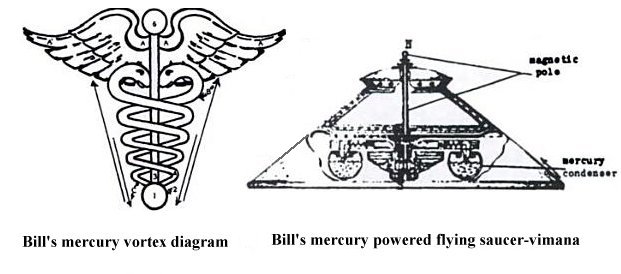
The controversial text known as Vimaanika Shastra, said to be by Maharshi Bharadwaja, also describes in detail the construction of what is called the mercury vortex engine. This is no doubt of the same nature as the Vedic Ion engine that is propelled by the use of mercury. Such an engine was built by Shivkar Bapuji Talpade, based on descriptions in the Rig-veda, which he demonstrated in Mumbai (Bombay), India in 1895. I more fully explained this in Chapter Three of this volume. Additional information on the mercury engines used in the vimanas can be found in the ancient Vedic text called the Samarangana Sutradhara. This text also devotes 230 verses to the use of these machines in peace and war. We will not provide the whole description of the mercury vortex engine here, but we will include a short part of William Clendenon's translation of the Samarangana Sutradhara from his 1990 book, Mercury, UFO Messenger of the Gods:

"Inside the circular air frame, place the mercury-engine with its electric/ultrasonic mercury boiler at the bottom center. By means of the power latent in the mercury which sets the driving whirlwind in motion, a man sitting inside may travel a great distance in the sky in a most marvelous manner. Four strong mercury containers must be built into the interior structure. When those have been heated by controlled fire from iron containers, the vimana develops thunder-power through the mercury. At once it becomes like a pearl in the sky."

This provides a most simplistic idea of the potential of the mercury engines. This is one kind of a propulsion mechanism that the vimanas of Kali-yuga may use. Other variations are also described. Not only do these texts contain directions on how to make such engines, but they also have been found to contain flight manuals, aerial routes, procedures for normal and forced landings, instructions regarding the condition of the pilots, clothes to wear while flying, the food to bring and eat, spare parts to have, metals of which the craft needs to be made, power supplies, and so on. Other texts also provide instructions on avoiding enemy craft, how to see and hear what occupants are saying in enemy craft, how to become invisible, and even what tactics to use in case of collisions with birds. Some of these vimanas not only fly in the sky, but can also maneuver on land and fly into the sea and travel under water.

There are many ancient Vedic texts that describe or contain references to these vimanas, including the Ramayana, Mahabharata, Rig-veda, Yajur-veda, Atharva-veda, the Yuktilkalpataru of Bhoja (12th century A.D.), the Mayamatam (attributed to the architect Maya), plus other classic Vedic texts like the Satapathya Brahmana, Markandeya Purana, Vishnu Purana, Bhagavata Purana, the Harivamsa, the Uttararamcarita, the Harsacarita, the Tamil text Jivakacintamani, and others. From the various descriptions in these writings, we find vimanas in many different shapes, including that of long cigars, blimp-like, saucer-shapes, triangular, and even double-decked with portholes and a dome on top of a circular craft. Some are silent, some belch fire and make noise, some have a humming noise, and some disappear completely.

Does this mean that these are ancient vimanas that still exist today? Are they stored in some underground caverns somewhere? Or are they simply modern-built, using the ancient designs as described in the Vedic texts? The UFOs that have been seen around the world may not be from some distant galaxy, but may be from a secret human society, or even military installation. However, many of the Vedic texts do describe interplanetary travel. So even if these space machines are from some other planet, they may be using the same principles of propulsion that have already been described in the universal Vedic literature. The answer awaits us. 


Related Posts Plugin for WordPress, Blogger...